Dayton Hamvention key spotting …

Friday night, May 18, 2012 – I’m sitting in my hotel room listening to “American Pickers” while my wife reads a book. We spent the day at Hamvention, and had a great time! The only problem was there was never enough time to get around it all.

My wife convinced me to reserve a mobility scooter for the event, and I’m thankful I did — while it was a pain in the ass navigating inside, it sure took the stress out of walking it all.

One of the first destinations I set was the Vibroplex booth. It was a beautiful Friday and the guys parking cars at Salem Mall told us the crowd today was way ahead of the last few years. Inside aisles were full!

I found Scott Robbins busy making a sale while two other guys were talking to others at the booth. They had just about every Vibroplex model on display hooked up to what looked like two dozen code practice oscillators of every make, model and size.

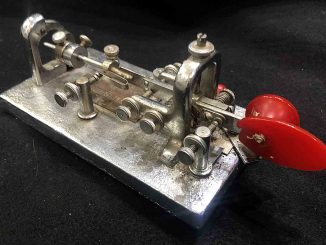
I got to see the Vibrocube in person — both the “standard” version and the not-yet posted on the website “Deluxe” version. The deluxe one has a chrome base and all chrome upper parts — its an excellent looking key, and while chunky, it certainly looks balanced. The large paddles have a good feel to them, and I’m thinking I could use one and enjoy it. I’m still not crazy about the painted upper parts on the “standard” Vibrocube, but I wouldn’t sell it if I got one for my birthday (ahem!).

I got a chance to look at the Vibroplex keys with the new Knoxville nameplates too. I don’t know how well they will hold up over time, but the plates all look fine … different from the old brass ones, but it wouldn’t stop me from buying a key.

I had a chance to see the 100th Anniversary Vibroplex Original with the Knoxville plate, and with what appears to be the new “Knoxville” finish on the base. Oh, its still black with gold carriage striping, but the black finish is different from what the ones sold under Vibroplex owner Mitch W4OA. The earlier black finish is semi-gloss; the finish on the 100th Anniversary key at the Vibroplex booth was a much duller black, almost a matte or satin finish. The finish looked like it would be more difficult to scratch and scuff, which is a good thing. The earlier black finish was more fragile, or at least that’s what I’ve heard.

My wife took my photo with Scott, which I hope turned out. While I was talking with him, I asked him about his plans to bring back the Lightning Bug key. He kind of hemmed and hawed about it, just saying he would love to, but he just hasn’t gotten around to it yet. Apparently there’s still some work to do to get parts produced, but he did say it was still something he wanted to do. I told Scott that my one request is that when he does bring back the Lightning Bug he offer it in the same finish (weathered black with gold pinstriping) as the 100th Anniversary bug.

I didn’t get my photo of the “new finish” 100th Anniversary key, but I decided today that I’ve got to have a “Knoxville”-made 100th Anniversary bug. What strikes me funny is the fact that the 100th Anniversary key is only $25 more than the standard, modern black textured finish. Who wouldn’t prefer the classic pre-war finish over the modern one?? I probably should have asked Scott if he had a special deal for hamfest purchases.

I ran into a bunch of folks from home, and it was great to see them among the throngs of people. I’m so accustomed to going to hamfests and knowing familiar faces that I was a little off my game because I didn’t know a damn soul when I walked in the doors. I spent quite a bit of time at the ARRL Expo, ran into a bunch of folks there I knew via the League and from home. The DIY stage had some excellent presentations.

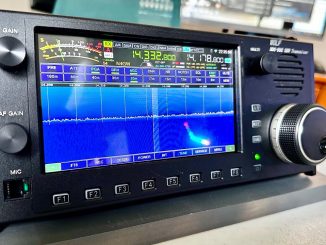
YAESU FTDX-3000. I didn’t get around all of Hara inside, I tried to be picky about where I went. I made it a point to stop by the Yaesu booth, and saw my next radio, the FTDX-3000. I’m not sure where in the price spectrum this rig will fit; I haven’t really reviewed he spec sheet closely, but I love the look of it. I don’t know when they’ll have it ready to release, but I’m goingto watch it closely.  I know Kenwood has their new rig, the TS-990, but I didn’t get by their booth. I don’t know exactly why, but the look of the TS-990 doesn’t turn me on.

I pushed my way to the Ten Tec booth to get a good look at their dynamic retro-look microphone. It looks nice — and I would love to get one for my shack. We’ll see. One favorable thing on the mic is that even my wife thought it was attractive.

I saw a several radios I would love to take home, but the truth is I didn’t have a place to put them at home. But another good sign was that my wife said once she gets her kitchen completed I have the green light to get something for the shack. She didn’t define the “something” and neither did I … it might be a Hallicrafters SX-101A/HT32A station or a FTDX-3000.

I did not run across the noted key collectors, most of whom I’m sure where there. I only saw a couple of keys for sale while taking our tour of the boneyard, and the prices were nothing to write home about. I really didn’t expect to find any bargains on keys anyway.

It’s good to be home tonight, with dreams of Morse code keys dancing in my head … g’night!

Posted in bugs, ham radio | Leave a comment

Bunnell Gold Bug weight

Sunday, May 13, 2012 – I’ve had a request for dimensions for the weight that is used with the famous (infamous?) Bunnell Gold Bug.

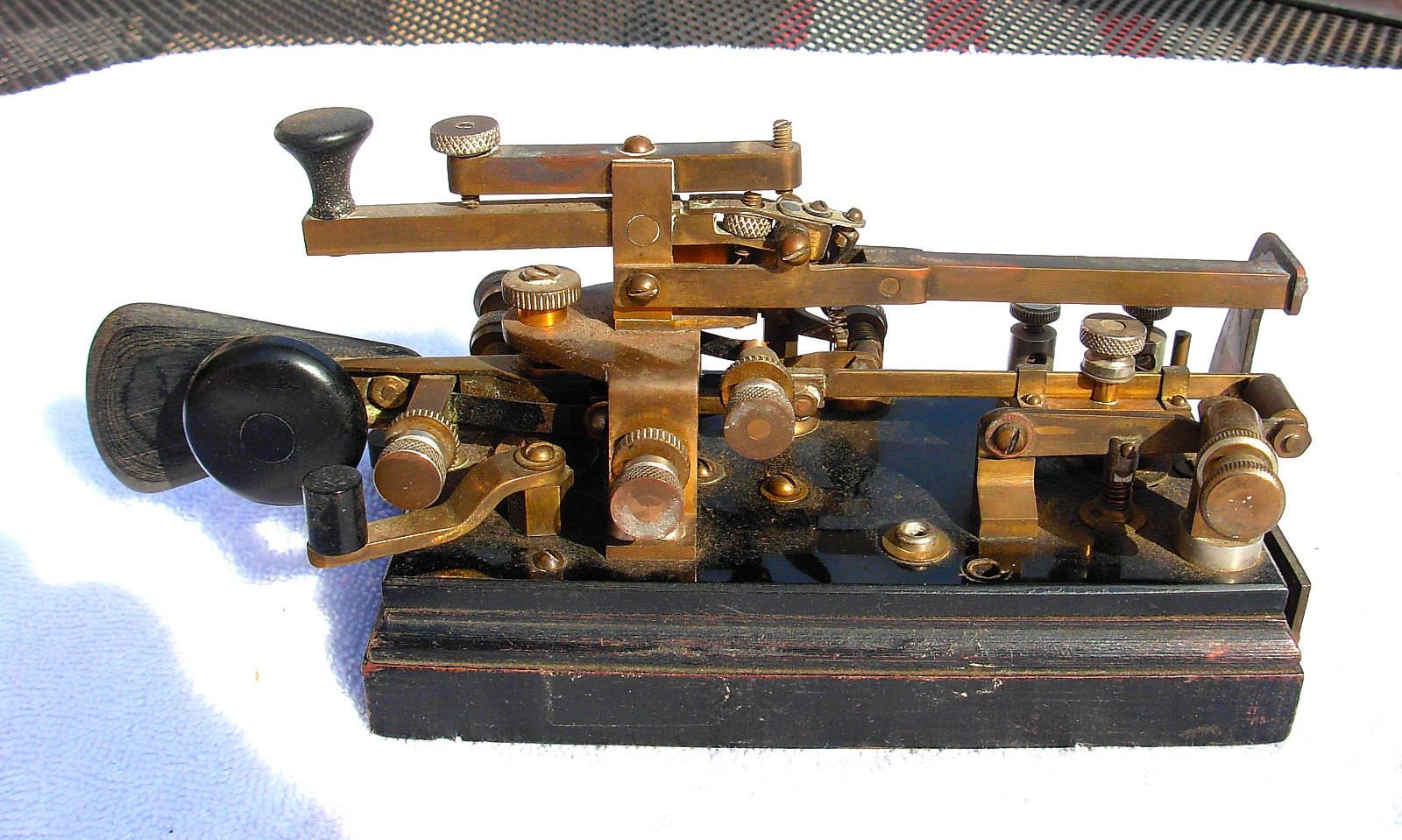
The Gold Bug was a 1920′s key designed to get around Vibroplex patents on its vibrating lever design. The Vibroplex lever vibrated after the lever hit its travel stop; the impact set the lever into motion. The Gold Bug idea was the movement of the lever removed the tension on the vibrating lever, so it vibrated. The lever, returning to rest, preloaded the lever spring so it would vibrate once it was time for more dits … moving the lever took the tension off the lever and it vibrated.


The weight (pictured here) is unique. For starters, the weight bottom is shaped like a “U” channel; this keeps the weight secure on the end of the Gold Bug vibrating rod. The “U” shaped track keeps the weight riding on top, it can’t shift left or right.

The oblong slot in the track allows adjustment forward and backward. The weight does not weigh a great deal; if I were making a replacement, I would make two — a replica of the original, and then a second one with a much longer track (and perhaps somewhat larger and heavier) to allow me to slow the key down.

The Gold Bug is not known as a stellar design or good performer anyway. It has a very different feel, that’s certain.

I shot this photos and meant to also give some measurements; however I was unable to find my micrometer or anything else to offer decent measurements. I’ll find something to get some measurements with and post those as soon as I find a measuring stick.

-30-

Posted in bugs | Leave a comment

Like my Elmer said, ‘A man can never own too many Cedar Rapids bugs’ . . .

Latest acquisition is a Cedar Rapids bug with metal carrying case.

Sunday, May 13, 2012 - I don’t know how many Cedar Rapids bugs I own, but I know its several. They are good performing keys, and I have always liked the damper — the key is one of the few that tried to create a key that didn’t “clank” as much as many other semi-automatic bugs (as many Old Timers point out to Young Whipper Snappers today, one big source of noise is if you adjust the key for a great deal of pendulum throw. Not only does it make the key clanky, it’s more tiring on your arm and wrist to slap the key around).

I was attracted to this fine example of the Cedar Rapids bug for a couple of reasons. The first is the fact it had a case. I have seen (somewhere) a Cedar Rapids bug with what was believed to be a factory (or perhaps aftermarket?) metal carrying case. As you can see in the photos, the case isn’t exactly a deluxe one. It’s form from galvanized steel. The bug is a tight fit into the unlined, unpadded case. The door on the end has a latch, but no lock.

The Cedar Rapids bug tucked snuggly in its metal carrying case. The case is made of galvanized steel. Click to enlarge.

This is not a rare key at all, but the case intrigued me, mainly because I have casually been looking for ways to create inexpensive, durable cases for my bugs. Not that I want to sell them, but it sure would be nice to have a more permanent box to store each one in, and perhaps make them easier to stack.

This Cedar Rapids key is complete, save for a missing screw on a weight. It has the factory cord, and the key is in mint condition. It hardly looks used.

RADIO VS. TELEGRAPH? One interesting note is that this key was offered as a “telegraph key” rather than a “radio key” by its maker, the Electric Specialty Manufacturing Co. What’s the difference between the “radio” key versus a “telegraph” key? The only difference is the circuit closer. The radio key did not need a circuit closer — it was a feature however that was needed if the key was used in a telegraph circuit. The Cedar Rapids bugs were available in both flavors, though it seems to me most of the ones I see are of the “radio” flavor.

All Vibroplex keys had circuit closers until the Champion model was introduced about 1939. It was considered a key for Amateur Radio use only, and did not need a circuit closer. It’s sibling bug, the Vibroplex Zephyr, was sold with a circuit closer. The only other difference between the Champion and Zephyr models was the Zephyr base was 1/2-inch narrower.

Side view of the Cedar Rapids bug. The key is in wonderful condition, just not exactly super rare. A dependable performer often overlooked by newbies seeking to buy a first bug.

PACKING? WHAT PACKING? I have been buying bugs via eBay for … a dozen years or more, and my family members can tell when a box in the mail is a bug. They’ve also learned the “feel” of trouble in a shipping container with a bug — the telltale rattling of parts, the dents in the box created from inside the box, and the feel of a 4-pound mass moving freely inside. Its news I dread, and sure enough, the Priority Mail box had a distinctive, sickening “thunk” when you moved the box around. Ugh!!

Once in the shack with my precious cargo, I opened the box to find two big wads of shipping paper, with one layer or so wrapped around the carrying case with the Cedar Rapids bug inside. As usually happens, an item with any weight will easily compress wadded paper used as packing; at that point, the item has room to “fall” inside the box every time it is moved. And worse, it felt like the key was also banging around in the carrying case. Double ugh!!

A couple of small wads of paper were stuffed in the open end of the case to “pack” the key and keep it from moving (mega packing FAIL). I gingerly extracted the key, and the only evidence of damage I found were some very small chips on the bottom edge of the thumb piece (the paddles on these keys frequently come loose in shipping, and this one had dropped so its lower edge was resting on the key’s base. The small chips were the result of the key’s movement inside the case. Not severe injury to be sure, but certainly an aggravating one.

UNREASONABLE EXPECTATIONS? When I buy a bug, I expect the seller to pack it well. There are some wonderful sellers who go above and beyond the call of duty when it comes to careful packing. These sellers are a joy to buy from, there’s never any question the key you buy is going to arrive in the same condition it was in when it was shipped. But then there are sellers — some of whom have feedback numbers in the thousands — who don’t seem to understand that an item with a lot of mass is going to flatten wadded paper when used for packing. From time to time, I have e-mailed a seller my “suggestions” for packing a key, particularly one of the few that were the more collectible ones. Invariably, the sellers I send the instructions to have been selling keys nearly as long as Vibroplex has made them.

ETHER CLIPPINGS FEEDBACK. I receive a steady stream of comments about my (mostly) incoherent ramblings in this blog, and I appreciate those who take time to read and comment. Just for the record, please understand that I do not count myself among the upper echelon of key collectors. I have neither the money nor spouse to allow me to pursue those highly prized super-collectible ones. I don’t own a tiger-striped based Mecograph, nor do I own an Autoplex. Heck, I don’t even own a Vibroplex Model X (yet!).

But I am a fan of CW and a big fan of Morse keys in general. I love buying bugs and putting them on the air whether they are rare or not. One part of my hobby is following those rare keys as they show up on eBay … please, if you decide to part with your own keys via eBay, for the sake of others like me who enjoy examining collectible keys from afar, please use larger, higher quality images with your auction ad. I’ll probably never operate a Mecograph, so your high-quality photos may be as close as many of us will ever get to giving one a close examination.

I have another homebrew bug on its way, will post photos when it arrives. And can you believe I nearly won (another) 100th Anniversary Vibroplex bug?? It’s a sickness I tell ya!

-30-

Posted in bugs, ebay | Leave a comment

Attic trip may reveal some hidden (forgotten) ham radio treasures …

Friday, April 27, 2012 – Due to a major renovation project in the kitchen of our home that involves rewiring the room, my wife, son and I were forced to cross the Forbidden Zone and move Attic Stuff from its longtime resting place to another location. The electrician who will be here in the morning must have unfettered access to the attic floor in order to cut access to an electrical junction thingie, etc. etc.

The National NCX-500 has an input power rating of 500 watts input on SSB/CW, 125 watts input on AM. This rig and its sister rig, the NC-200, were uncovered in my attic this evening. Click to enlarge.

The only really positive to this forced march into Attic-dom was the fact it was April and not August; it was stuffy and hot, but not sweltering. Much of the stuff archived in the attic was moved half a dozen years ago, and include some interesting ham gear.

For a period of time, I was trying to acquire every piece of vintage ham gear I wanted as an SWL and later Novice class ham but could not afford. The boxes in the attic included a Hallicrafters SR-150 and matching supply; a National NCX-200 transceiver with supply; a National NCX-500 transceiver and supply; a couple of MFJ antenna tuners I didn’t remember buying, and various and sundry ham accessories.

And right after we cleared the attic where the electrician will need to be, we retired to the library and caught part of an episode of “Antiques Roadshow” on public television. It made me wonder what the attic goodies might bring if I tried to sell them.     None of the HF rigs mentioned have been out of the box since I bought them … well, I take that back, the NC-200 did get unboxed, but immediately repacked. After seeing the specs on the NCX-500 I’m very tempted to hook the rig up! At 50 percent efficiency, its still 250 watts on SSB, and that’s not bad.

Of course, I don’t know if any of these rigs are operational; allegedly they were, but that was back in the day when things were sold “working” that mysteriously failed en route.  I have a real desire however to unbox all those rigs and give them a go before sending them on their way. At least those rigs have parts you can see without 20 x magnification.

Drake TR-7 and PS-7 power supply. Click to enlarge.

NEW DRAKE: MAKE OR BREAK. My long awaited Drake TR-7 transceiver and matching supply arrived today in two separate massive boxes. The power supply box looked like half a dozen bobcats were fighting inside it, it had nearly lost its rectangular shape. I opened the shipping box and inside I found the power supply had been packed with foam rubber — like the kind used in seat cushions! Arrggh! There’s probably no WORSE packing material one can use to pack something an item so dense and heavy! I didn’t not completely unpack the PS-7; lets hope it works, as I had planned to sell it off.

The TR-7 weights less than the heavy supply, so its shipping box fared better. I did not take time to open the box and check on my new prize. I’m hoping it fared well and can go into service sometime this summer … just imaging running the thing mobile! Can’t imagine a dashboard manufactured in the past 25 years that could hold the Drake, much less have room for the install.

I’ve just about sworn off buying boat anchor rigs on eBay; the protection of your purchase depends on the ability of the seller to properly package your purchase, and I have had too many instances where an item arrived safely only by the grace of God — the packing job was horribly insufficient (case in point, the PS-7 that arrived today).

Enough rambling for tonight … off to bed.

-30-

Posted in ebay, ham radio, radio | Comments Off

This episode is titled, “Can you hear me now?” or “VF-Oh No!”

Saturday, April 21, 2012 — I had a break in the home action and thought I would quickly check out a 1960s VFO accessory I picked up at a recent hamfest. The seller is a fellow ham whom I’ve known for years, and he had this same unit for sale last hamfest season. I wanted it then but figured he would sell it before I had the cash-in-hand.

When I saw he still had it for sale, I snapped it up. It’s a fairly clean (not mint) example of this manufacturer’s VFO, and perfect for a Novice rig I own. He’s told me for months the story of him checking it out and testing it, and making a CW contact with just the VFO as the transmitter, QRP style.

Unfortunately, when I plugged the unit in and turned it on, nothing! Zip! Zero! Nada. GRRR!

Removing the unit from the case revealed a fuse holder that had been jumpered in place and a 6BA7 tube with a broken envelope. The tube filaments are wired in parallel, so why none of the tube lit escapes me … the dial lamp, which is powered by the 6.3 v secondary, did not light either.

My first suspect is that fuse holder that was haywired in place. The snap in fuse holder has bare clips to hold the fuse, and the whole thing is flopping around about 1/8 inch from the chassis — possible short, which might blow the fuse. Other than that, I’m thinking the rectifier diodes may be shot, or the transformer. This is turning into a “project” I don’t need! I wanted to use the damn thing, not repair it!

I don’t have time today to mess with it or take voltage measurements, but I can do that before the new tube arrives (if I have time then). The VFO is not complicated, but its sure getting aggravating. Sheesh!

I hope I see my ham friend and he asks about the VFO. I’m going to go easy on him, but one question I want to have answered is simply “During which decade did you last operate this VFO?” I’m not sure it was anytime this century!!

-30-

Posted in ham radio | Comments Off

Putting the ‘key’ back into ‘Morse code key’ . . .

Saturday, April 21, 2012 – Yeah, I’ll be the first to admit it — I am a sucker for all things a little off-kilter, even goofy, when it comes to Morse code keys.

My new Morse "key" key. Click to enlarge.

With that disclaimer, let me introduce my latest purchase … its not a Vibroflex anything, a Mac-Whatever or a Speed-Z key. It’s an homebrew key that I snagged in an impulsive “Buy It Now” frenzy Friday night. And yes, its crafted from what appears to be a real brass key.

So how would you describe it … eclectic? Goofy? Sentimental? Semi-mental? Ugly-as-sin? Or just plain “fugly?” Regardless of the description, something inside my mouse finger was driven — no, required — to click the “Buy It Now, Dammit!” button.

My new Morse key's "brother," built with a shorter key.

The seller actually had two of these kinds of keys listed, this being the more attractive of the two (“attractive” being a relative term in this instance, of course!). The other key was shorter. Initially I thought perhaps the seller made these keys, but after looking at their listings it is obvious he/she buys items at estate auctions and sells them on eBay. The other electronics this seller has are old transformers, variable condensers and parts from the shack of an old timer.

The Buy It Now was $16.95 — certainly cheap enough for me to rationalize the purchase of a conversation piece. K6VDH used to make a Morse straight keys that used a handcuff key.   They were attractive keys for what they were, very well executed.

EDDYSTONE BUG

ON THE PROWL. There are some really great keys for sale on eBay this week, though I unlike Pokemon, I can’t “catch them all!” Just not enough money at the end of the month. Besides, the Big Guns will be watching these keys because they are the more collectible ones.

One of my favorite rare keys is the British Eddystone bug. I was extremely fortunate to snipe the one I have because it did not bring the high price they usually bring due to a photography error. One of the key’s main photos had a shadow that made the key appear as if the aluminium “shell” that covers the key had a sizable dent. In fact, I sniped the key believing it had the dent. Knowing how collectible these keys are, I was just tickled to have one — even a dented one. The one listed on eBay now has two full days left and is already nearing the $150 mark. Had my Eddystone not appeared dented, I doubt I would have been able to afford it!

I don’t need many excuses to buy another code key, but I need to consider buying some keys simply for their parts. I have several keys in need of parts in order to make them complete. Of course, nearly every “parts key” I’ve purchased I’ve decided to “save” from being dismantled, so even that can be a problem. My son asked me if I was a hoarder … I replied, “No son, at least not until I finish filling my shack with keys, and I still have five feet of space above all of my desks to get to that point.”

FOR A FINAL. I am expecting a non-Morse eBay item in the mail today or next week — I finally decided to purse a Drake TR-7 transceiver. This one was nabbed worth the money and comes with the Drake PS-7 (not a big deal to me, I’ll probably sell it).  I’ve wanted one forever, and got it worth the price. Of course, that was before I realized we needed to pay state taxes worth about half what I paid for the Drake. Ugh! I don’t expect to replace my FT-2000 with the Drake, but I do want to give the rig a try. First I have to make room for it in the shack. Wish me luck, lol! 73.

-30-

Posted in bugs, CW keys, ebay, ham radio | Comments Off

“We are the (Vibroplex) Champions, my friends …. “

First year of production 1940 Vibroplex Champion.

Friday, April 13, 2012 – The old tale about Friday the 13th being unluck is absolutely fiction — and I have conclusive proof to back up my statement! In this morning’s mail I received one honey of a key — Vibroplex Champion Serial No. 114,829.

This is a very early Vibroplex Champion model as the serial number dates it to 1940, which was the year the key was introduced. I believe this is the third Vibroplex Champion I own, and certainly one of the most unique ones.

This first year of production 1940 Vibroplex Champion has a unique box-style hinge, the style Vibroplex dropped in 1923. On occasion, Vibroplex keys of this era are found with the old-style box hinge.

While it is interesting since it is a very early Champion, the real fascinating part is that this key uses the old style “box hinge” for the dash lever hinge. In 1923, Vibroplex switched from the “box hinge” for the dash lever hinge to a much simpler “bent lug” design. The “lugs” are part of the dash lever, and are bent at a 90-degree angle so they can serve as the hinge; the pivot rod that supports the keying lever also serves as the “pin” for the bent-lug style dash lever hinge.

The box hinge style disappeared from Vibroplex keys in 1923, only to surface in a few keys made about 1940. It’s kind of a mystery to Vibroplex historians why the box hinge resurfaced after nearly 20 years. There are lots of theories floated about, but the one I think is most plausible is that they found a sizable cache of old parts somewhere in their shop and decided to make use of them.

The difference in hinges means nothing to the customer; its a hinge, it works or it doesn’t. But moving forward 70 years, you have to wonder why the used the old-style parts.

The parts are not NOS (new old stock), because the original parts from that era when finished would have been nickle plated. These parts are chrome plated like the rest of the parts on the key. Vibroplex switched from nickle to chrome plating about 1939/1940 if I remember correctly. The parts were finished to match the standard finish for upper parts at the time, but it certainly is the same old box hinge of old.

As you can see, the key is used but in overall good shape. You can see the wear on the right side of the base from  use. This Champion is a little rare, as you don’t see many of the early ones with black bases sold on eBay. The vast majority of Champions you see have the grey base.  Other than visible wear on the base, the key is in excellent condition. I’m not real sure why the name plate looks so “antiqued.” Not sure if it is dirt and grime, or if that was the intended finish by the company or a previous owner. The key looks excellent, so I doubt it’s dirt and grime.

I didn’t pay too much for the key, given how unique it is. I don’t believe I own another early Champion, so it fills a “slot” in my key collection.

Posted in bugs, CW keys, ebay | Comments Off

Homebrew Review: Two homebrew bugs added to my collection offer variety, craftsmanship

Sunday, April 8, 2012 — I’ve uploaded some more photos to the Photo Gallery under “Bugs, Rare, Unusual” to showcase a couple of new keys I picked up in recent days from eBay.

LADIES & GENTS, MEET ‘COPPER.’ This is a very well designed and constructed homebrew bug that is a diamond in the rough at present. The thick, metal base was copper plated; as you can see, it was very professionally built, and other than the contacts being dirty, the key plays extremely well. I was quite surprised!

The pivot frame is a very simple affair, and in some ways resembles the Vibroplex Model X in that regard. The keying lever is build like a standard “Original” model Vibroplex, right down to the “bent lug” design of the dash lever  hinge. Vibroplex made that change about 1923, and I suspect this key was build in the 1930s. After WWII, surplus bugs were extremely cheap, though guys still built their own I suppose.

The damper on this key also resembles the “t-bar” design damper Vibroplex used for a short time in the 1920s.

The copper plating has worn off the sides of the base on both sides, apparently from the key’s being handled while in use. There’s some corrosion on the other plating, but not bad. Since I shot the photos I’ve clean up the base some, and it will shine like a new copper penny if polished. The key was quite a looker in its day!

HOMEBREW TWO. This homebrew bug isn’t quite as slick as the one above. It has some interesting design features that make it noteworthy. I’m fortunate that people seem to steer away from spending much money on homebrew bugs; I enjoy buying them because of their “character.”

The pivot frame and horizontal arms are fashioned of brass flat stock. The vertical part of the pivot frame was notched to accept the horizontal arms, which are also bolted. Its a very sturdy and very simple arrangement. Click to enlarge.

Homebrew II has a brass base and pivot frame. The pivot frame is fashioned out of brass flat stock; as you can see in the photo above and in the detail photo, the vertical portion of the pivot frame is notched to accept the two horizontal “arms.” And believe it or not, the assembly — even though bolted together — is sturdy and quite sound.

The adjustment screws and nuts are just that — standard screws and nuts. The contact screws have some sort of contact that may simply be a blob of flattened silver solder. The keying lever’s mainspring (unlike Vibroplex keys, which are riveted) is bolted with a single bolt. The damper is a very simple screw the end of the weight rod is designed to strike.

It’s noisy, true, but the reason became apparent when playing with the key. There is no hinge to create a pivot for the dash lever; when you press the lever to the left, you wind up loading the lever by pushing it against the righthand stop. The tension added to the mainspring (with the end of the lever solidly against the damper screw) is what returns the  keying lever to the neutral position. It sounds unorthodox, but it works really well!

The key needs a good cleaning; the photos are the key as it arrived here. I’m not sure I can make the key play without some serious refurbishment on the dot and dash contacts, they seem pretty worn. I’ll update more after I give they a closer look.

That’s all this trip! Have a great Easter Sunday!

-30-

Posted in bugs, CW keys, ebay, ham radio | Comments Off